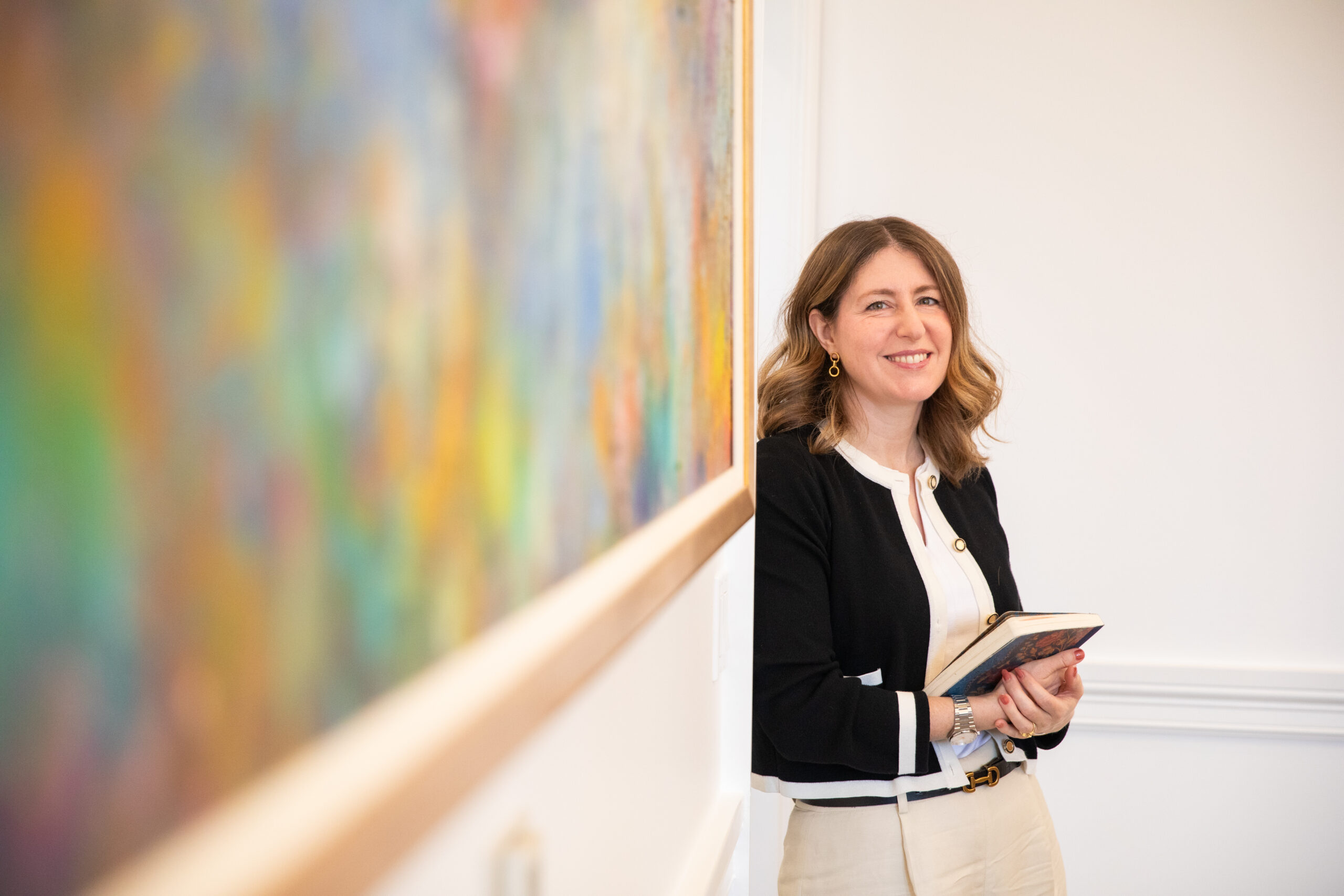
Amy Rogan-Mehta brings a deep understanding of the student journey and the strategy and operations of a university to her leadership at Chapman University. Her perspective comes from experience—starting as a student at a large state school; transferring to a smaller, more personal learning environment; and building a career across social work, law, and higher education. In this Q&A, she reflects on how those experiences guide her leadership, support the university’s priorities, and shape what comes next.
You’ve seen higher education from many vantage points—student, practitioner, administrator, and leader. How do those experiences influence how you show up in this role?
In this role, it’s important to understand and work well with all of the different groups that make up our community. Students are obviously at the forefront, but we also work together with faculty, staff, and administration, parents, supporters, board members, and alumni. Higher education is complex, and while we all share the same love for the university and the same focus on wanting our students to thrive and our faculty to deepen their work, there are different perspectives and different priorities.
Having worn some of those hats myself helps me shift between those perspectives and bring us back together around our larger goals. I also think it’s important to remember what it’s like to be a student. I remember how nervous I was in law school, where they use the Socratic method—being called on in class or standing up to give a presentation made me sick to my stomach. Those moments may not seem so daunting to us now, but they matter deeply to students.
Our students may also be working or have family responsibilities. Reflecting on our own student experiences—and now, as I’m starting the college search with my daughter—helps keep that perspective front and center. It reminds me how important it is to put ourselves in students’ shoes on a regular basis.
Your own path through higher education took shape over time. How has that experience influenced the way you think about students and their journeys today?
Early on, I didn’t know exactly what I wanted to do, and while I probably looked like a strong student on paper, I didn’t have the kind of guidance or mentorship that might have helped me finish in four years. I transferred, I took breaks, and I didn’t graduate until later in my 20s.
That experience informs how I think about students who are still figuring out their path. We have an important role to play in helping them understand that it’s okay not to have everything mapped out. It’s a process. When we help students identify their strengths and explore possibilities, we can help them build confidence and momentum.
I also saw firsthand the power of mentorship. That’s something we can do for students here every day—help them see their potential and imagine a future they may not yet be able to picture on their own.
You’ve spoken about the difference a more personal, supportive learning environment made for you later in your education. How does that perspective inform the work you’re doing at Chapman now?
A lot of the work I’m doing now involves working with leaders across the university and making sure we’re aligned at a high level on our priorities. One of those priorities is continuing to commit to personalized education and deepening it. We know who we are at Chapman, and we don’t want to veer away from that. We’re always looking for ways to make it even more meaningful.
It’s important to really understand what we mean by personalized education—that it’s not just a catchphrase. It means we know our students. We have deans who know their college’s students by name. We have a senior vice president for student affairs and dean of students who is approachable and visible, who students can walk right into his office to see. We have a president who brings his dog to campus and creates moments where students can connect with him in a very human way. Our staff are talented at forming connections with students. Whether they are student-facing or more behind the scenes, they light up when they talk about working with or helping a student. Those things matter, and they make this place different. You see it in the way our faculty work with students. They know their students well, they understand their goals, and they think big for them. They help students understand what the next step is and how to get there. Last year, 15 out of 16 Chapman alumni who worked closely with our pre-health advisor during the application cycle were accepted to medical school, both M.D. and D.O. programs. That’s a direct result of faculty mentoring and the hands-on support we provide to make sure students are putting their best foot forward and are competitive when they leave Chapman.
This work happens at every level. At my level, I’m working with other leaders to think strategically about where we focus our time and resources. We only have so many resources and so many hours in the day, so we’re constantly asking how we prioritize students and how we keep the experience personal—from the very first interaction students and families have with Chapman all the way through to helping students launch their careers.
Before higher education leadership, your work in social work and law focused on advocacy and access. What threads from that work still guide you today?
There are two things I think about a lot. One is being strengths-based. In social work, part of solving problems is looking at what’s already going well and how you capitalize on that. When you’re working with people, you’re thinking about what strengths they have and how you build on those. That transfers very well to working with students and to working with colleagues and organizations.
The other piece is being solution-focused. That’s key in both social work and the law, and so much of what I do now is trying to find solutions to problems so that we can help our students.
Another important thread is advocacy—helping people achieve what’s in their best interest. That was true when I was working with kids in the foster care system, and I think that carries through to how we think about students. If you keep students’ best interests at the forefront, that drives how you think about the decisions you’re making.
You have a big role and portfolio. Talk about a typical day and the common bonds that connect your division and how you help align that work day to day.
I’m often meeting with campus leaders and with the executive leadership team, and many days are filled with brainstorming, seeking feedback, and working on specific initiatives. Things often come up on top of what’s already planned, and the days move quickly.
Some of my favorite days are when I get to meet with teams and get to know people better. I also love our annual traditions at Chapman—Winterfest is one of my favorites, as well as the annual holiday brunch. Commencement is incredible. Being a part of our students’ and their families’ joy is so special. We have so many meaningful traditions, and those moments give me a chance to connect with people across our campuses.
In terms of the common bonds that connect the division, being student-centered and student-focused runs through everything we do. We can get very immersed in our work and in improving or optimizing it, but it’s always important to step back and ask how students are experiencing what we’re doing.
Another thread is that some of the areas I work with are internal-facing and student-focused, while others are more external-facing. That makes it important to think about how we tell Chapman’s story. There’s so much about the university that isn’t always as well understood as it could be. When people come to campus, you can see their eyes light up as they experience not just the physical environment, but the culture here. Thinking about how we communicate that sense of place and culture externally, in a strategic way, to strengthen our position regionally and nationally is another thread that runs through the work. We all play a role in that.
You’ve talked about the energy that comes from connecting people and ideas. How does bringing teams together across the university strengthen Chapman’s academic mission?
When you pull back and look at things from a higher vantage point, you realize that many of our goals are actually very similar, even though our work looks different day to day. We want to bring the best and brightest students to Chapman. We want to support our faculty’s scholarly and creative work. We want our students to thrive and to grow into careers that are meaningful. We share all of those goals.
When we’re more siloed, our collective efforts aren’t as effective as they could be. We’re not bringing the full strength and talent of the Chapman community together. That’s something that I love doing—helping to connect the dots. Bringing about that collaboration, helping to connect the dots across teams, deepens what we’re able to accomplish.
“Magic happens—in terms of learning, in terms of professional development—within relationships.”

Chapman has built a reputation for excellence over the years. How do you see the university continuing to maintain that standard?
We have an incredible president and an executive leadership team, and I feel very privileged to be a part of it. Our students, faculty, and staff are the key ingredients to our success. When I look at the priorities President Parlow has set—continuing to support our students and highlight their success, building on our academic excellence, deepening our commitment to free speech and civil discourse, and creating bridges both between disciplines and between the university and the community—those priorities are rooted in who we are. Continuing that momentum into the future matters.
We’re extremely fortunate because we’re building from a position of strength. You’re seeing some other universities struggle, and we’re going into a time that is more challenging for higher education. Chapman is uniquely positioned to capitalize on the momentum we currently have. It’s a group effort, and we’re very committed to building on the strengths that have gotten us to such an incredible place in a short period of time. By that, I mean the last 30 years—transitioning from a small regional college to a mid-sized national university, with a growth trajectory that—as President Parlow has noted—is the envy of so many universities. That’s special, and we will continue to build on that.
“Chapman is uniquely positioned to capitalize on the momentum we currently have. It’s a group effort, and we’re very committed to building on the strengths that have gotten us to such an incredible place in a short period of time.”
When you’re not working, what do you enjoy doing?
I love going to the movies. It’s nice to step out of everything for a bit and have an experience where you get to use your imagination and step into a completely different world for an hour and a half. Sometimes you’re moved by something, or it helps you reflect on your own life. I really love that experience.
I also love going to Dodge College events and seeing movies there. I sometimes bring my children with me, which is a lot of fun. I always say I’m going to see all the movies that are up for Best Picture, though I usually end up seeing one or two. Watching the Oscars has always been a tradition for me—my mom, sister, and I used to watch together when I was younger—and I still enjoy that.
Spending time with my kids is really important to me. They’re 12 and 16, and I’m very aware that my time with my 16-year-old at home is limited. We recently went to the Huntington Library together, which was a lot of fun. I also enjoy walking and hiking when I can. I don’t get out into nature as much as I’d like to—it takes a bit of driving from where I live—but when I do, I really love it.
Leadership Snapshot
- Born in the Chicago suburbs
- Triple-degree holder from Saint Catherine University, Columbia University, and Marquette University Law School
- Graduated first in her class from Marquette Law School
- Eight years at Chapman
- Roles at Chapman: Associate Dean for Administration at the Dale E. Fowler School of Law; Senior Vice President of University Advancement; and Executive Vice President and Chief of Staff
- Big wins: Played a key role in Inspire: The Campaign for Chapman University, expanding employer and alumni engagement to create stronger, measurable career pipelines for students—resulting in record employer participation. Led historic gains in student and institutional success at the Fowler School of Law.
- Enjoys mentoring students and spending time with her family, including her husband, two children, and their German Shepherd
Story by Cristine Gonzalez Hall | Photos by Andrew Castro