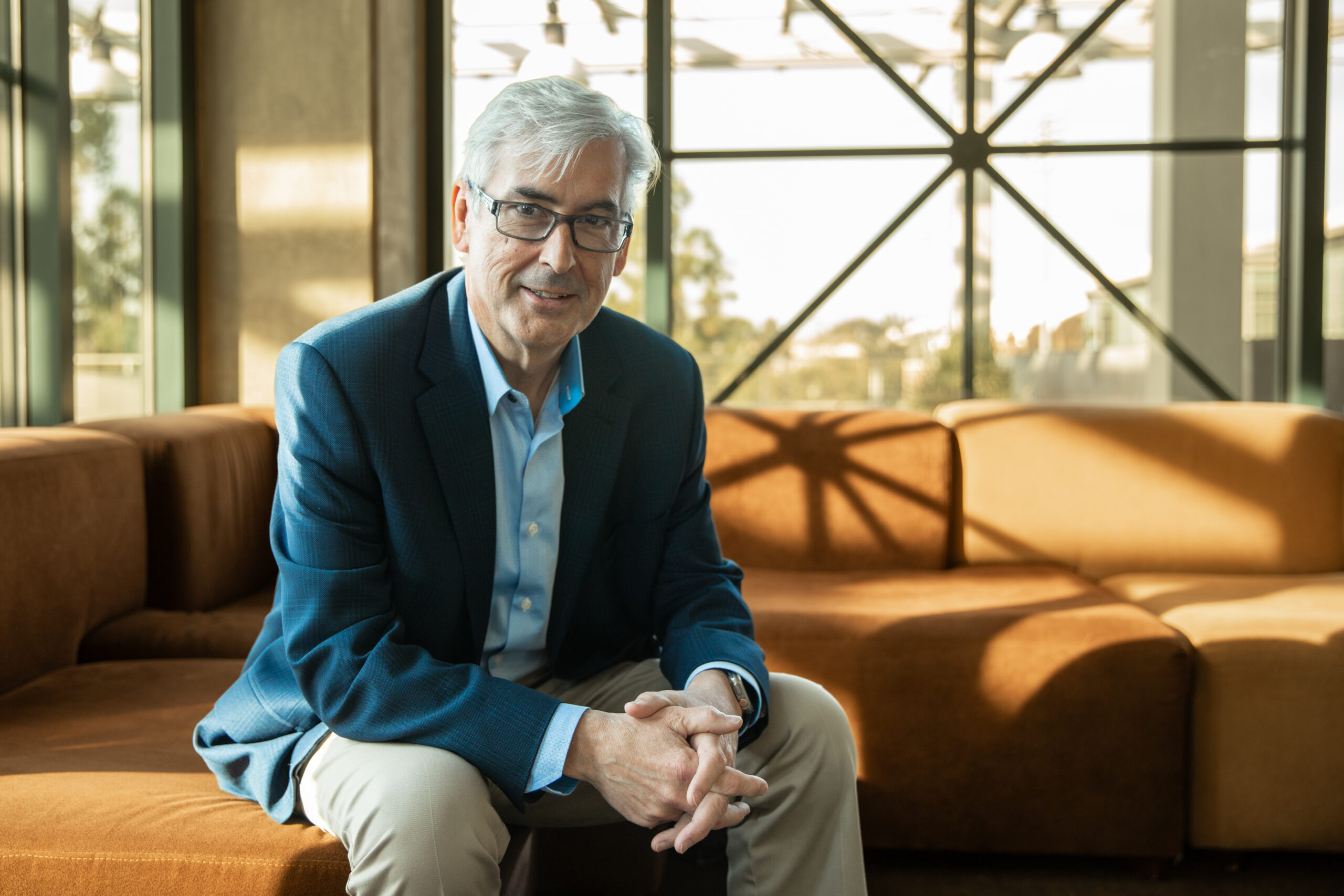
Rick Bischoff comes to Chapman with a strong track record of leading enrollment growth at highly selective institutions, most recently at Case Western Reserve University. Long before he traveled the country speaking about enrollment strategy and trends, however, Bischoff was a first-generation college student from a small rural town, choosing his own college sight unseen from pamphlets in the local library. In this Q&A, he discusses Chapman’s enrollment momentum, his approach to leading through change—and he offers one piece of advice to parents of college-bound students: stay out of the way.
This role comes with a long legacy of leadership at Chapman, spanning years of growth from a small institution into the university we know today. What from that history has stayed with you, and how does it guide how you approach this role?
That history was important to me. Chapman’s trajectory of growth—in terms of enrollment and academic programs—is highly unusual. With the addition of new schools and colleges, the facilities, the number of signature spaces on campus, it’s unbelievable, I mean unbelievable.
It’s very exciting to see the foundation that leadership within enrollment management has laid and to have the opportunity to take that foundation and extend it. President Parlow has been very clear in his ambition for the university to attract students from all over the country. We’re heavily regional right now, but there are students across the country who would find this a very appealing place to be.
Chapman has achieved remarkable enrollment momentum over the years. What do you see as essential to preserving that standard of excellence as conditions change around us?
At both the graduate and undergraduate levels, there are real external pressures: federal loan change, fewer undergraduate students nationally, increased competition. That creates some interesting dynamics.
You have universities more competitive than us admitting students who used to come here and universities less competitive than us using scholarships to attract students. So, in that environment, you have to preserve the things that make Chapman distinctly Chapman and then take that message to a broader audience.
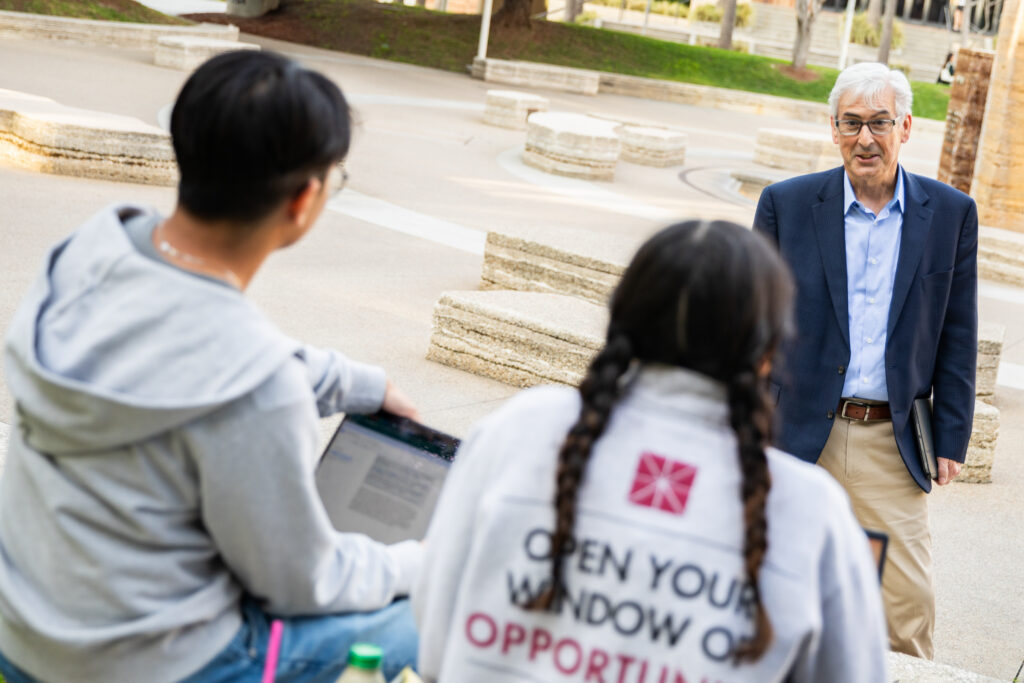
Universities are navigating enrollment cliffs, economic uncertainty, and shifting student expectations. How do you approach leading through a moment like this?
In terms of the demographic cliff, we’re actually in a really good position. An economist out of Carleton College found that top national colleges and universities are in a relatively strong place because we can draw nationally. We’re also located in a part of the country that isn’t seeing the same declines as the Northeast or Midwest.
Over the next 10 years, states like Illinois are expected to see a significant decline in high school graduates. If Chapman were located there, it would be a very different outlook. Being in a region with population growth, combined with our ability to recruit nationally, puts us in a good position.
We’ve also navigated COVID and the FAFSA disruptions. You take complexity in stride and keep looking down the road. The question is always: How do we position ourselves so we have choices five years from now?
You’ve described Orange as America’s best college town—hands down. What makes that belief so strong for you, and how does that sense of place factor into how we attract and support students?
The proximity of Old Towne Orange to campus, the coffee shops, student-friendly places to eat—it’s an extension of campus. This is my fifth institution, and I’ve never seen anything quite like how students use this space. When my wife and I visited, we walked into Old Towne and saw Chapman students everywhere.
Students actually use the town. It’s not just nearby—it’s part of the experience. My wife is a college counselor, my son just went through the college process, and I’ve seen a lot of campuses. No place would have given him access to the kind of social, cultural, and everyday experiences students have here.
Enrollment work often sits at the intersection of data, strategy, and human connection. How do you balance analytics with the deeply personal nature of students’ college decisions?
One of the things I love about enrollment work is that it’s an unusual intersection: We have to do good for the university, do good for students, and do good for the broader community.
We educate students in ways that are transformative—for them, their families, and future generations. And we can attract talent to Orange County that contributes to the economy here.
There’s no conflict between data and remembering that students are at the center of this work. The tools we have today are remarkable. When I was searching for colleges in the 1980s, I had to drive 30 minutes to the county library to look things up. Now everything is at students’ fingertips. It’s more complex, but our ability to reach students is far greater.
Enrollment success touches everyone—student affairs, advancement, alumni, faculty. How do you see collaboration across campus fueling Chapman’s next phase of growth?
I certainly hope, if you were to go around and talk with folks here, that they would tell you that I’m a good partner. I’m acutely aware of how the work that we do touches everything else that happens on campus, at both the graduate and undergraduate levels.
I recognize that our colleagues in alumni engagement, Student Affairs, and the schools all bring expertise to the table that I don’t have. You have to lean on that expertise and respect it. When you bring that kind of respect to relationships, that’s a great start to collaboration.
“Whatever we do on the enrollment side, we need to make sure we’re protecting what students love about Chapman while also finding ways to improve their experience.”
For faculty and staff who care deeply about Chapman’s mission and culture, what do you want them to know about how you’re approaching this work?
I’m here because of Chapman’s mission and culture. One of the things I’ve loved about my career is that I’ve worked at very different kinds of institutions.
At each place, I learned that to embrace the culture and personality of the institution. You cannot change it. Even if you wanted to, institutions are living organisms. Trying to change what a place fundamentally is—that’s a fast road to failure.
I had this experience when I returned to Macalester, my alma mater, with my son in 2019. It had been 30 years since I graduated. We did the information session and campus tour, and it was by far the best of any visit we did. It was still 100 percent Macalester—different people, different facilities, but the ethos was the same.
I believe the same is true here. Chapman is Chapman. My job is to be at a place that fits me and my skill set, embrace what it is, and work within that. That’s what I’m going to do.
You are an admissions professional but also a parent. How did you help navigate your son’s college search process and decision? What lessons did you learn?
My wife and I just stayed out of it. You can imagine—I’m a vice president for enrollment, my wife is a college counselor—and we stayed out of it.
We had one meeting with his college counselor, and I said to her, “If you need us, you know where to find us. We will not be calling you.” We told our son that we did not want to see his college essay until after he had submitted it, because we were afraid we would want to make it better, and it needed to be his voice.
We set the parameters early—especially around finances—and then let him do his thing. He ended up going to Skidmore with a tuition exchange scholarship, which is an incredible benefit for faculty and staff.
What excites you most about the opportunities ahead—not just for the university, but for the students who will choose Chapman in the years to come?
Two things: I’m excited to get out and tell the Chapman story—to students, parents, and counselors who may be less familiar with the university—and help them understand what this place really is and why it’s worth a serious look.
And, I’m excited to get to know our current students better—to understand the culture, why they chose Chapman, and what they value about their experience here. Whatever we do on the enrollment side, we need to make sure we’re protecting what students love about Chapman while also finding ways to improve their experience.
When you’re not working, what do you enjoy doing?
I have two dogs—Wirehaired Pointing Griffons. I love my dogs. My wife is here with me, and my son is in Cleveland and will stay there.
We’re a big sports family—huge Cleveland Cavaliers fans, huge Guardians fans. It’s hard to be a Browns fan right now.
I enjoy exploring new cities and finding out-of-the-way places. I also mountain bike. I normally keep my bike in Colorado, but I brought it here because I understand there’s good riding, and I’m looking forward to exploring Orange and the rest of Orange County.
Story by Cristine Gonzalez Hall | Photos by Andrew Castro