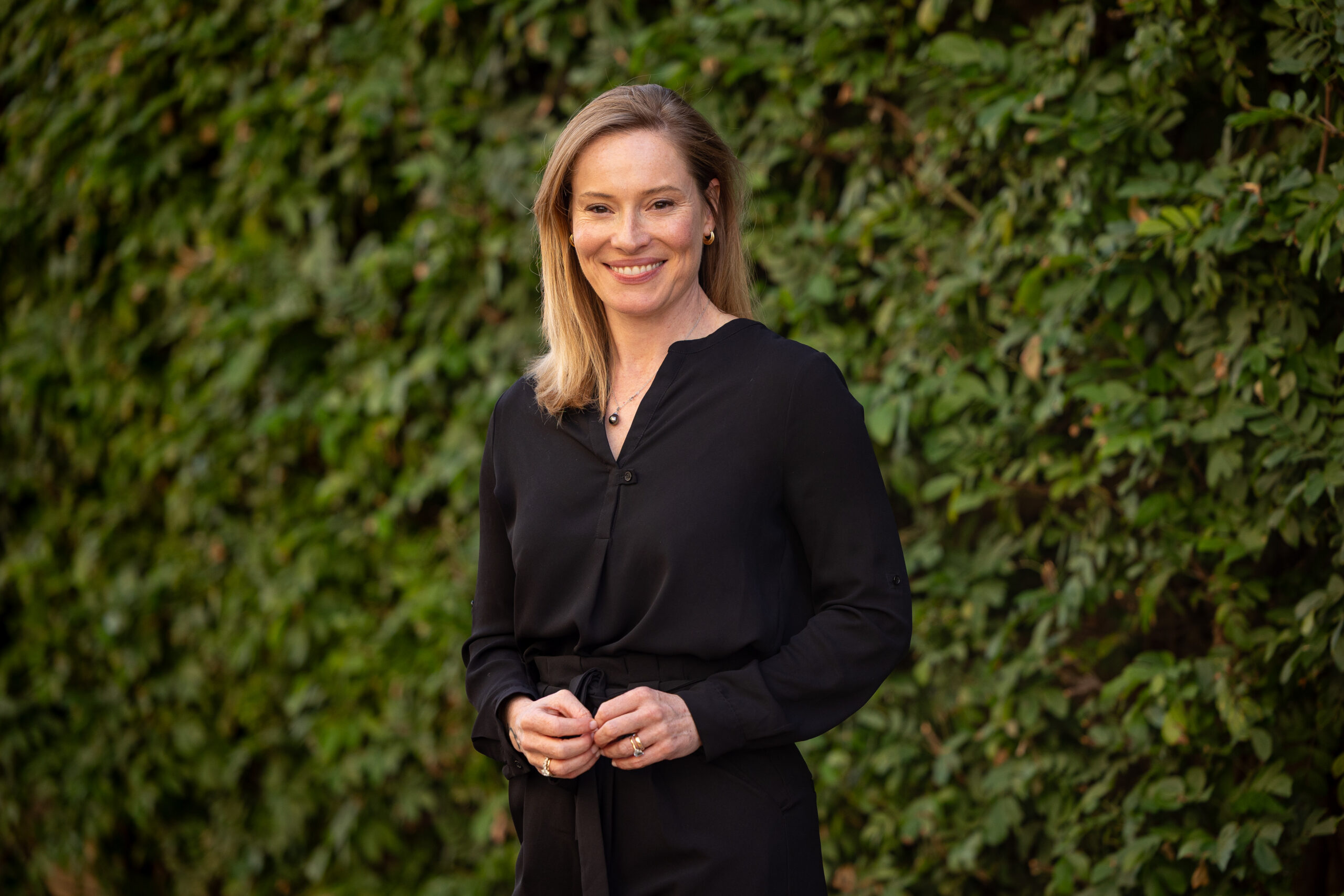
Kelli Fuery, Ph.D., brought a lot to her role as president of Chapman’s Faculty Senate: 15 years of experience at the university, a global academic career, and a passion for keeping faculty at the heart of shared governance. In the fall, she will chair the Department of Creative and Cultural Industries (CCI) in Wilkinson College of Arts, Humanities, and Social Sciences. When she’s not teaching or researching, you’ll likely find her with a baking project in the oven, knitting needles in hand, or deep into her latest read.
You’ve had an international academic career with academic posts in Australia and England. What brought you to Chapman, and what’s kept you here?
My husband, Dr. Patrick Fuery, and I applied to come to the States around the time of the global financial crisis — 2009. Chapman was one of the only universities hiring at the time. We had three young boys, and we made this decision to just go on an adventure. A family of five to California, a complete unknown.
What’s kept me here is that I’ve been lucky enough to work across several parts of the university — Wilkinson, the Honors Program, Dodge College, and back to Wilkinson as CCI was taking off. That kind of journey isn’t something you can do at a large institution.
Something I like most about Chapman is that we respond quickly and positively to innovation. There are people here — staff, faculty, and senior administration — who want to help bring your ideas to life. I like to think of it this way: smaller animals can move with speed and adapt faster to the environment. That’s how I think about Chapman. It’s a dynamic place that can respond quickly to changes in the global landscape.
Meet the New Faculty Senate Leaders
Kelli Fuery will remain the Faculty Senate President for another year. The Faculty Senate recently held elections for the upcoming academic year. The new Senate Executive Board members are:
- Faculty Development Council Chair
Hagop Atamian, Ph.D. - Faculty Governance Council Chair and Director of Communications and Records
Gordon Babst, Ph.D. - Faculty Personnel Council Chair
Drew Moshier, Ph.D. - Graduate Academic Council Chair
Adrian Vajiac, Ph.D. - Long Range Planning Council Chair
Anuradha Prakash, Ph.D. - Undergraduate Academic Council Chair
Julye Bidmead, Ph.D.
For those unfamiliar with Chapman’s Faculty Senate, what is it and why does it matter beyond faculty?
The Faculty Senate is the primary representative body through which Chapman’s faculty participate in shared governance of the university. Senators are elected from every college, school, and the Leatherby Libraries and, together, we address issues that shape the academic life of the institution — curriculum, academic standards, hiring and promotion policies, and educational and long-range planning.
Almost everything the Senate deals with impacts the whole university community. When we shape curriculum or academic standards, we are shaping the student experience and protecting academic freedom. Decisions on faculty awards, sabbaticals, tenure and promotion, and strategic direction affect people’s well-being and pride in working and learning here. The Faculty Senate exists to make sure the people closest to teaching and scholarship have a real voice in how the university operates, and that voice ends up benefiting everyone.
You’re set to chair Chapman’s new Department of Creative and Cultural Industries, which launches its first major this fall. What inspired the program?
Creative and Cultural Industries as a field emerged out of the U.K., where publicly funded institutions helped to identify and support a broad umbrella of creative employment — film and television, music, fashion, heritage management, events, sport, and tourism. We thought there was a space for us to bring CCI to the United States that would increase recognition for Chapman nationally and internationally.
We started with a CCI minor. We wanted to start out small, and we had a projection of about 20 students. Within five years, we’ve had close to 300 students select the minor, and that’s without any marketing or any other targeted strategy to recruit students. We are the first degree-granting institution to offer it here in the U.S.
How do you describe your research and teaching interests?
My Ph.D. was in philosophy, concentrating in continental critical theory, which I apply to concentrations of visual culture. I’m particularly drawn to feminist and existentialist phenomenology, which at its core is about how we take responsibility for our actions through our engagement with what we see, watch, and observe. And I also draw on psychoanalysis as a method to explore lived experience: the choices we make about how to exist, and our capacity to learn from emotional reality rather than flee it. Whenever I bring psychoanalytic theory into my teaching and my research, students really respond to it.
That thinking carries into my next book, Bizarre Objects. It takes Wilfred Bion’s concept of the “bizarre object” — developed through his work on schizophrenia — and extends it to aesthetic experience. At its heart is the argument that hallucinations are not anomalies but constitutive sensory experiences that help establish shareable realities, and that we cannot think through difficult experience alone. We need another mind to help us bear it — whether that’s an analyst, a group, or the media we share.
“Smaller animals can move with speed and adapt faster to the environment. That’s how I think about Chapman. It’s a dynamic place that can respond quickly to changes in the global landscape.”
— Kelli Fuery, Ph.D., professor and incoming chair of the new Department of Creative and Cultural Industries
What do you hope the Chapman community knows about you that they might not learn from your CV?
My CV makes me sound like a serious person, which is mostly a clerical error. It won’t tell you that I decided to do this role because I enjoy being part of building community, and getting to know the strange, brilliant people in it. I genuinely believe the best ideas usually come from the people who aren’t trying to win the room.
Finally — what do you do to unwind?
I love to bake — cakes, biscuits (that’s cookies, for Americans), pies. I’m also a pretty dedicated knitter. I recently finished a baby blanket for our grandson Finn, who is 15 months old now, so I need a new project. And I’m an avid reader. Two books in firm top-five position that I recommend to everyone: Raising Hare by Chloe Dalton and The Goldfinch by Donna Tartt.
Outside of that, family keeps me busy. My eldest son Morgan is a fire medic in Colorado with his wife Lindsy and baby Finn. Noah graduated from Chapman’s Fowler School of Engineering and is now a software engineer at Roku. And my youngest, Josh, is a junior in software engineering at Chapman — he’s heading to NASA’s Jet Propulsion Lab this summer for an internship. We also have a beautiful 3-year-old beagle mix named River, who is very adored.
Story by Amanda Sapio and Photos by Nathan Worden