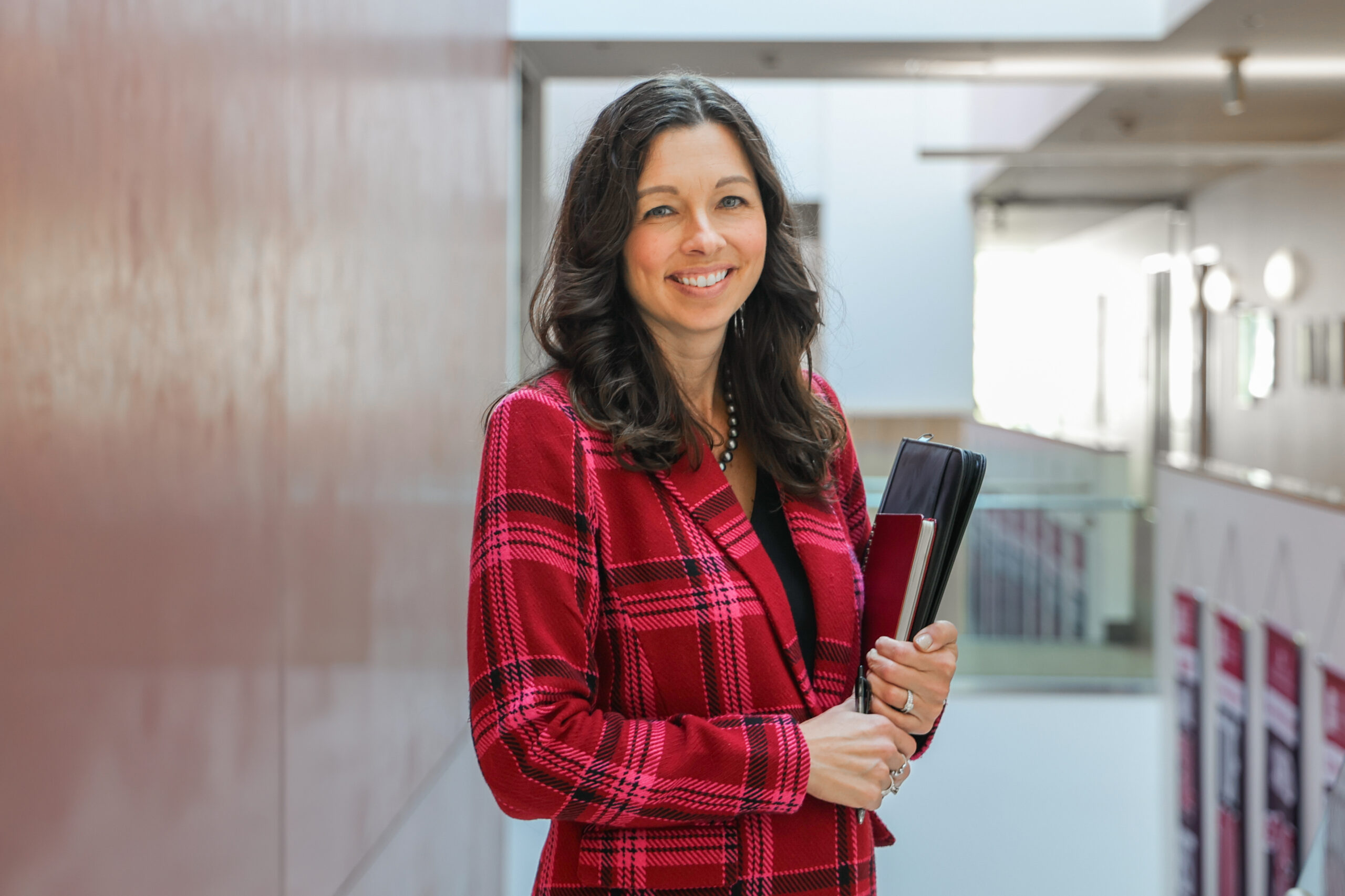
Jessica Berger did not take a traditional path to advancement. Shaped by a childhood in Ohio and early work in social advocacy, she came to the field with a deep belief in education’s power to transform lives. Now at Chapman, she’s leading Inspire, a $500 million campaign that is the most ambitious philanthropic effort in the university’s history. In this Q&A, she reflects on her path to Chapman, her vision for the future of philanthropy here, and how meaningful relationships sit at the heart of it all.
What drew you to Chapman, and what excites you most about the university’s trajectory right now?
The people. From my very first conversations, it was clear that this is a place where people genuinely care about one another and where student success is a shared commitment across the entire community. The “Chapman Family” is both authentic and powerful.
Chapman is on a remarkable rise, and it is an exciting time under President Matt Parlow’s leadership. We are advancing academic excellence, expanding access, and investing in experiences that prepare students to lead meaningful lives and careers. The Inspire campaign reflects that momentum—it’s not just about reaching a financial goal, but about accelerating impact. There is a palpable sense that the best chapters of Chapman’s story are still ahead, and it is incredibly energizing to be part of that journey.
You grew up in Ohio, where your parents worked in a factory and didn’t have the opportunity to attend college. How has that experience shaped the way you think about access to education and the role philanthropy can play in expanding opportunity?
My parents are two of the hardest working people I have ever known, and two of my biggest supporters. I wouldn’t be where I am today without them. They instilled in me strength and resilience, a will and determination to never give up, and a drive to always follow my dreams. They also instilled in me a deep belief in the power of education, even though they themselves didn’t have access to it. They sacrificed a lot to provide for my brother and me, and one of their greatest prides was seeing that we received an education that would open doors to endless possibilities. Before my father passed away, my husband and I established a scholarship in his name, and it was one of the greatest gifts that I could have given him.
For me, this work is deeply personal. I’ve always had a passion for education and carried a strong sense of responsibility to help expand access for others. Education truly changes lives—it opens doors, builds confidence, and creates pathways that have a ripple effect on families and communities. That’s where philanthropy plays such an important role. Every scholarship, every program, every investment in student support represents not just a gift, but a belief in someone’s potential.
Your early career was rooted in social work, from constituent advocacy on Capitol Hill to supporting rebuilding efforts in India after the 2004 tsunami before earning your master’s in social work. How did you become interested in that work, and how did those experiences lead you to a career in higher education?
While I wasn’t sure exactly what I wanted for a career, and I recognize this sounds cliché, I knew I wanted to make a difference and work with people who were invested in a mission together that brought great purpose. Because of that, I was drawn to social work. I’ve always been drawn to work that centers on people through listening, understanding, and helping create pathways forward. My early experiences in social work were formative. They taught me the importance of empathy, resilience, and meeting people where they are.
They also helped me understand that lasting impact often requires not just addressing immediate needs but building opportunities that endure over time. Higher education became a natural extension of that work. It is one of the most powerful engines for long-term change. At its core, advancement is all about lifelong relationships and bringing people together around shared purpose, to connect generosity with opportunity in a way that transforms lives. In many ways, I still see myself as a social worker at heart, just operating at a different level of scale and impact.
You’ve now spent nearly two decades in advancement leadership. Looking back, what surprised you most about the field when you first entered it—and what keeps the work meaningful to you today?
What surprised me most when I first entered advancement was how deeply relational the work is. It’s not transactional; it’s built on trust, shared values, and a genuine connection to mission. Philanthropy is, at its core, about people and purpose. What keeps the work meaningful is that it never becomes routine. Every conversation is different. Every person has a unique story, a unique motivation, and a unique vision for impact. And at the center of it all are our students—their aspirations, their challenges, and their successes.
There’s something incredibly powerful about navigating through a journey together with someone, building vision, and translating their values into action. When a person sees the direct impact of their generosity—whether it’s a student who can stay enrolled, a faculty member advancing research, or a new program coming to life—that connection is transformative for everyone involved.
You’ve talked about building a “culture of philanthropy” at the institutions you’ve served. What does that phrase really mean in practice, and what does it look like when it’s working well on a campus?
A culture of philanthropy means that there is a deep understanding of the impact that philanthropy has on campus, that we are all stewards of the institution’s future, and that relationships matter. In practice, it means that faculty, staff, alumni, parents, students, and friends all see how their roles contribute to something bigger. It means celebrating impact, telling stories, and helping people understand how generosity fuels innovation, access, and excellence. When it’s working well, you feel it across campus. There is pride, ownership, and a sense of collective momentum. And supporters feel deeply connected, not just to the institution, but to the people within it.
Chapman’s Inspire campaign is the most ambitious philanthropic effort in the university’s history. Advancement work can often happen behind the scenes, but it touches nearly every part of the university. What would you want faculty and staff to understand about the role their everyday interactions play in building philanthropic relationships?
Faculty and staff are integral to our advancement efforts. The most meaningful philanthropic relationships are built on authentic experiences, and those experiences happen every day in classrooms, labs, studios, pool decks, fields, and offices across campus. A conversation with a student, a moment of mentorship, an innovative idea—these are the stories that inspire philanthropy. Donors give because they see the impact of this work in action.
In many ways, faculty and staff are some of our most powerful ambassadors. When they share their passion, their vision, and their commitment to students, it creates a connection that no brochure or presentation ever could. Advancement simply helps bring those stories forward and connect them with individuals who want to make a difference.
As we approach Giving Day and continue building momentum through the Inspire campaign, I hope everyone across campus feels a sense of connection to this work. Philanthropy is not just about resources, it’s about belief. It’s about investing in people, in ideas, and in a shared future.
Life has taught me to never take a day, or anyone in my life, for granted. I cherish the work that I get to be a part of and the people that I get to collaborate with in building something together that is meaningful and purposeful. I am deeply grateful to be part of the Chapman Family and excited for all that is ahead.
“Life has taught me to never take a day, or anyone in my life, for granted. I cherish the work that I get to be a part of and the people that I get to collaborate with in building something together that is meaningful and purposeful. I am deeply grateful to be part of the Chapman Family and excited for all that is ahead.”
You were a competitive swimmer and team captain in both high school and college. How did that experience shape your approach to leadership and teamwork?
Swimming taught me discipline, resilience, and the importance of setting goals and striving for continuous improvement. It’s a sport that requires both individual accountability and deep trust in your team. As a team captain and a coach, I learned that leadership is about more than performance; it’s about setting a tone, supporting others, and bringing out the best in those around you. It’s about showing up consistently, even when it’s hard (that includes 5 a.m. practices and hours of staring at a line on the bottom of the pool), and keeping your eyes on both the immediate goal and the long-term vision.
That mindset has stayed with me. Progress comes from small, consistent efforts over time, and from a shared commitment to something bigger than ourselves.
When you’re not working, how do you like to spend your time?
I love spending time with my husband, Alex, and our two dogs, Wolfie and Arnie, especially outdoors. Alex and I were both competitive swimmers and enjoy living near the ocean where there is fantastic scuba diving and water sports. We also enjoy giving back to the community and volunteer our time to local organizations and pet rescues.
Leadership Snapshot
-
- First-generation college graduate, Ohio native
- Graduated with honors from Wittenberg University (B.A. Psychology) and Cleveland State University (MSW)
- Joined Chapman in July 2025
- Prior roles span Cal State San Marcos, Harvey Mudd College, Polytechnic School in Pasadena, a children’s home in Kenya, and the U.S. House of Representatives.
- Big wins: Helped surpass Harvey Mudd’s $150M campaign goal, raising $175M; built and executed $200M campaign and secured first-ever eight-figure gifts at Cal State San Marcos; and produced the nation’s first case statement of support for social mobility.
- Established a scholarship at Cal State San Marcos in honor of her father
- Enjoys scuba diving, water sports, mentoring student-athletes, volunteering, and hiking with her husband and two dogs
Story by Nicole Bigley | Photos by Andrew Castro